
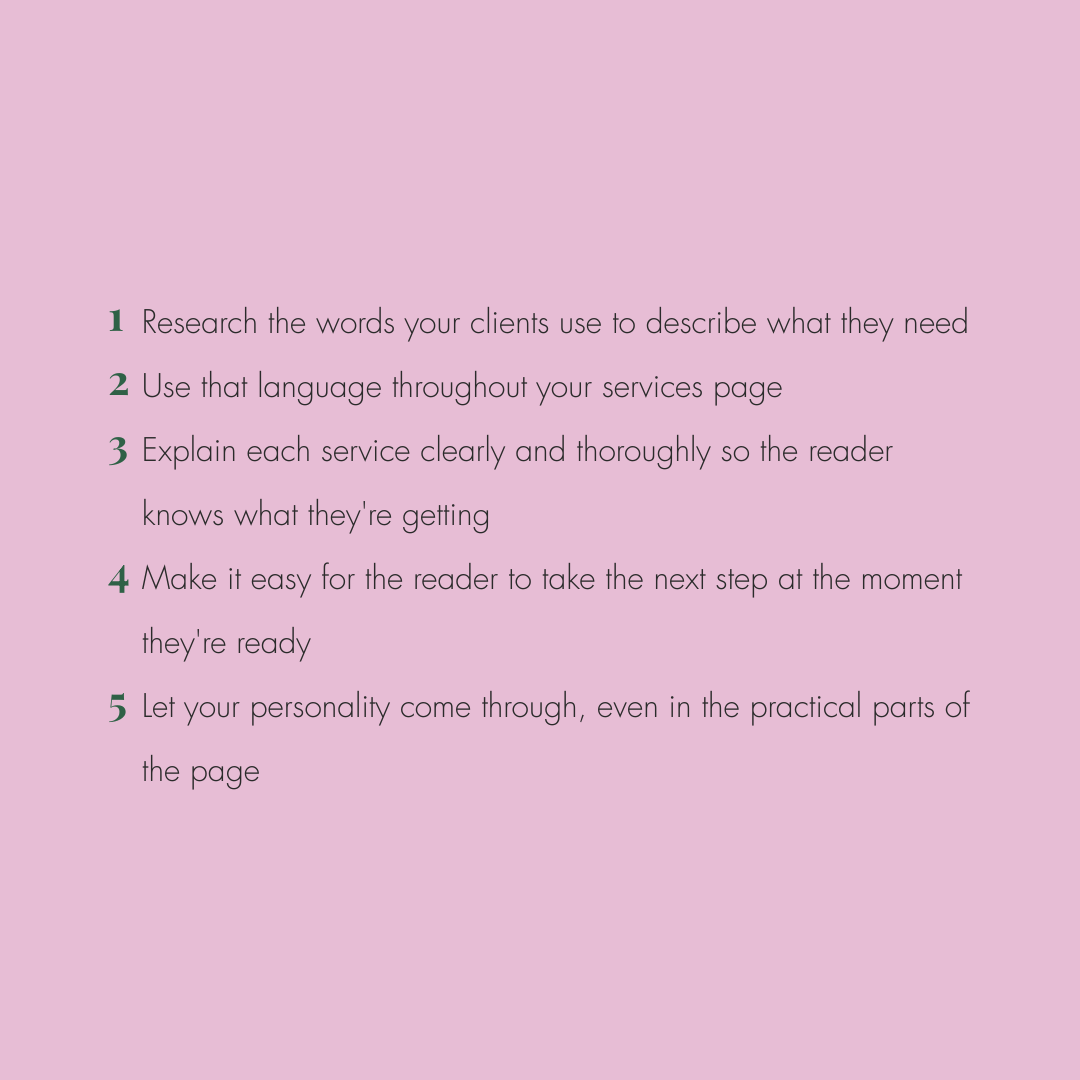
Five things your services page needs to get right
Your services page has a very specific job. It needs to take someone who’s landed on your website, already a little curious, but maybe a little unsure, and help them work out quickly whether you offer what they’re looking for. When it does that well, you are far more likely to get enquiries from people who are genuinely the right fit and already understand what they’re likely to get from you.
Here’s what to do.
Research the words your clients use to describe what they need
Your potential clients are searching using their own words, based on their own experience of the problem they’re trying to solve. It’s really easy to find these words and the best place to start is your own inbox. Look at how clients describe their situation when they first get in touch, before they’ve learned your language. Notice the phrases they use in enquiry forms, discovery calls and emails. You can also type your service into Google and pay attention to the suggested searches and the “people also ask” section, or look at the questions people ask in Facebook groups where your ideal clients engage.
If you’re starting out and don’t have a body of client enquiries to draw from yet, this kind of research does the same job. It grounds your page in the way your audience actually thinks and talks.
Try this:
Search for your core service on Google and screenshot the suggested searches and “people also ask” questions. These are real phrases real people are using, and they’re free research.
Use that language throughout your services page
If your page doesn’t reflect the language your clients use, they’ll assume you don’t offer what they need, even when you do. The patterns you find in your research belong on your services page, woven naturally into how you describe each service.
Try this:
Read back through your last ten client enquiries and note the exact words people used to describe what they were looking for. If someone consistently asks for “help doing my taxes” rather than “BAS lodgement and compliance support”, that’s the phrase to lead with.
Explain each service clearly and thoroughly so the reader knows what they’re getting
Each service deserves its own space on the page. For each one, aim to cover what it actually involves, who it’s the right fit for, what problem it solves and what the reader walks away with. You don’t need to write an essay, but you do need enough detail that someone can make a confident decision about whether it’s right for them.
Try this:
Read each service description and ask yourself: if someone read only this section, would they know whether to enquire? If the answer is no, it needs more.
Make it easy for the reader to take the next step at the moment they’re ready
Don’t save your call to action for the very bottom of the page. Someone who finds the service they need shouldn’t have to scroll through everything else to find out how to get in touch. Place a clear, specific call to action after each service description.
Try this:
Replace any generic “contact me” links with something more specific and inviting, like “book a discovery call”, “send me an enquiry” or “get in touch to talk about your project”. The more specific the invitation, the easier it is to act on.
Let your personality come through, even in the practical parts of the page
A services page needs to be clear and functional, but it doesn’t have to be dry. The way you describe your work, the specific problems you name, the clients you mention, the tone you write in, all of that tells a potential client something about what it would be like to work with you before they’ve even been in touch.
Try this
Read your page out loud. If it doesn’t sound like you, it probably needs another pass.
Your services page is often make or break for whether a visitor gets in touch. It’s worth the time it takes to get it right, and if you’d like a hand with it, I’d love to help.
⁂