The blogging asset loop
A lot of small businesses try blogging at some point. They publish a few posts, don’t see much happen, and quietly stop. It’s easy to conclude that blogging doesn’t work. But usually the issue isn’t blogging, it’s the approach.
What blogging actually is
A blog post isn’t a social media update. It doesn’t disappear after 48 hours or get buried by the next thing you publish. Done well, a blog post is an asset, it’s something that keeps working for you long after you hit publish. It can be discovered months or years later, updated as your thinking evolves, and compounded over time on a platform you actually own.
When you start thinking about your blog this way, the whole approach changes. Each post adds to a growing body of work that helps Google understand not just what you offer, but how you think, who you serve, and where your real expertise is. Over time, this builds the kind of visibility that organic search is designed to reward.
This is where blogging stops being a pile of individual posts and starts working like a system.
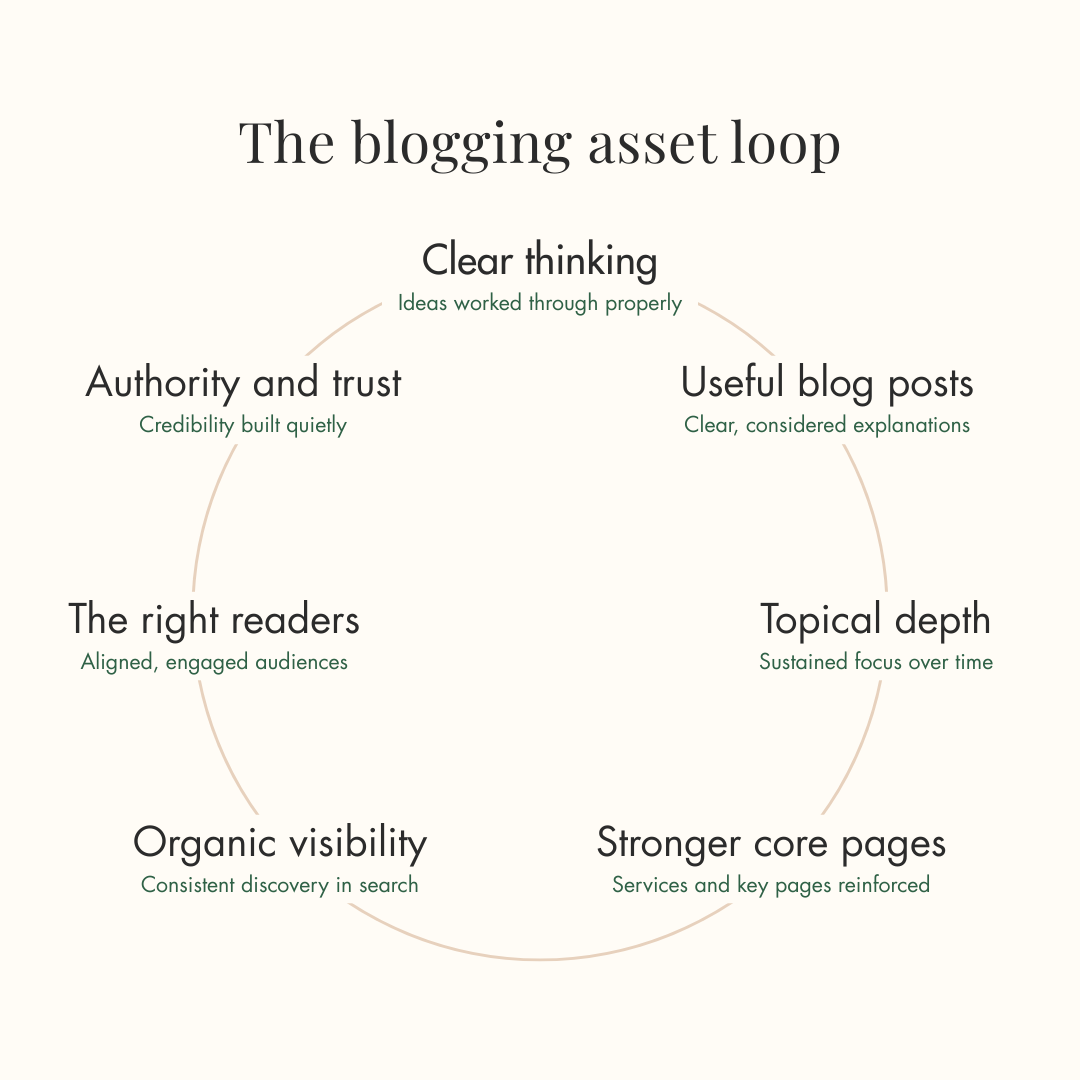
The blogging asset loop
I think of it as a loop. Not a checklist or a content calendar, but a self-reinforcing system where each element generates the next. Here’s how it works.
Clear thinking
It starts with ideas worked through properly. Good blog posts aren’t just information — they’re your thinking made visible. The act of writing it forces you to clarify what you actually believe about your work, your industry, and your clients. That clarity is valuable in itself, but it’s also usually what makes the writing worth reading.
Useful blog posts
Clear thinking produces clear, considered explanations. Posts that genuinely help people understand something, answer a real question, or reframe a problem they’ve been sitting with. These are the posts that get read, shared, and returned to. They’re also the posts that search engines are designed to showcase.
Topical depth
Over time, a consistent body of useful posts builds topical depth across your site. Google doesn’t just look at individual pages, it looks at the whole picture. A site with ten well-written posts on related topics signals genuine expertise in a way that a single page just can’t. Your blog posts support your core service pages and then strengthen their relevance in search too.
Organic visibility
As your topical depth grows, so does your visibility in search. Not overnight, and not all at once – but steadily and sustainably. The right people start finding you at exactly the moment they’re looking for what you do.
The right readers
Organic visibility brings in the right kind of reader. Someone who found you because your content was genuinely useful arrives already knowing you can help them. That’s a very different starting point to most other forms of marketing.
Authority and trust
Over time, consistently showing up with useful, well-considered content builds your credibility quietly. Not through self-promotion, but through demonstration. Your readers (and search engines) start to recognise you as someone who genuinely knows their subject. That authority feeds back into your thinking, your writing, and the quality of everything that follows.
And the loop continues.
Why this matters for your business
Blogging works well for small businesses because it doesn’t require a big budget or a large team. It requires consistency, patience, and a genuine willingness to be useful to the people you most want to reach.
It’s also one of the few marketing investments that compounds. The post you write today might not do much this week. But in six months, or a year, it could be quietly bringing in exactly the right kind of client – someone who found you because you took the time to explain something properly.
Blogging is honestly one of my favourite things to work on with clients. If you’re ready to start thinking about your blog as a long term asset, get in touch and let’s talk about what that could look like for your business.
⁂